Sensing points cover the whole bed surface, continuously measuring and mapping contact pressure distribution. PS90 has a 16 × 32 array of 512 points, PS180 a 32 × 32 array of 1024 — identical in principle and electrical specification.

Each sensing point is 20 × 20 mm with a 25 mm gap to its neighbours. Every point outputs an independent 12-bit pressure value and the whole surface refreshes five times a second, so load at the shoulders, back, waist, hips and legs can be read zone by zone. PS90 is a 16 × 32 single-person array; PS180 is 32 × 32 across the full double-bed width, imaging both sleepers independently.
Illustrative, drawn live by this page with simulated breathing — not measured data. PS90 is a single-person 16 × 32 array over a 750 × 1700 mm sensing area.
The mat does exactly one thing: stream the pressure value of all 512 or 1024 points at 12-bit resolution and 5 Hz, with no black-box processing in between. What happens above that is your call — feed it into your own system, or add our compute unit and posture algorithm.
The full array streams out over UART or USB as a digital signal, 12 bits per point. Calibration, filtering and higher-level algorithms stay in your hands.
The optional compute unit ships with the posture-monitoring algorithm, returning position classification and per-zone load directly — no algorithm development needed.
A wireless module is available where a cable is impractical — suited to multi-bed care facilities and mobile measurement setups.
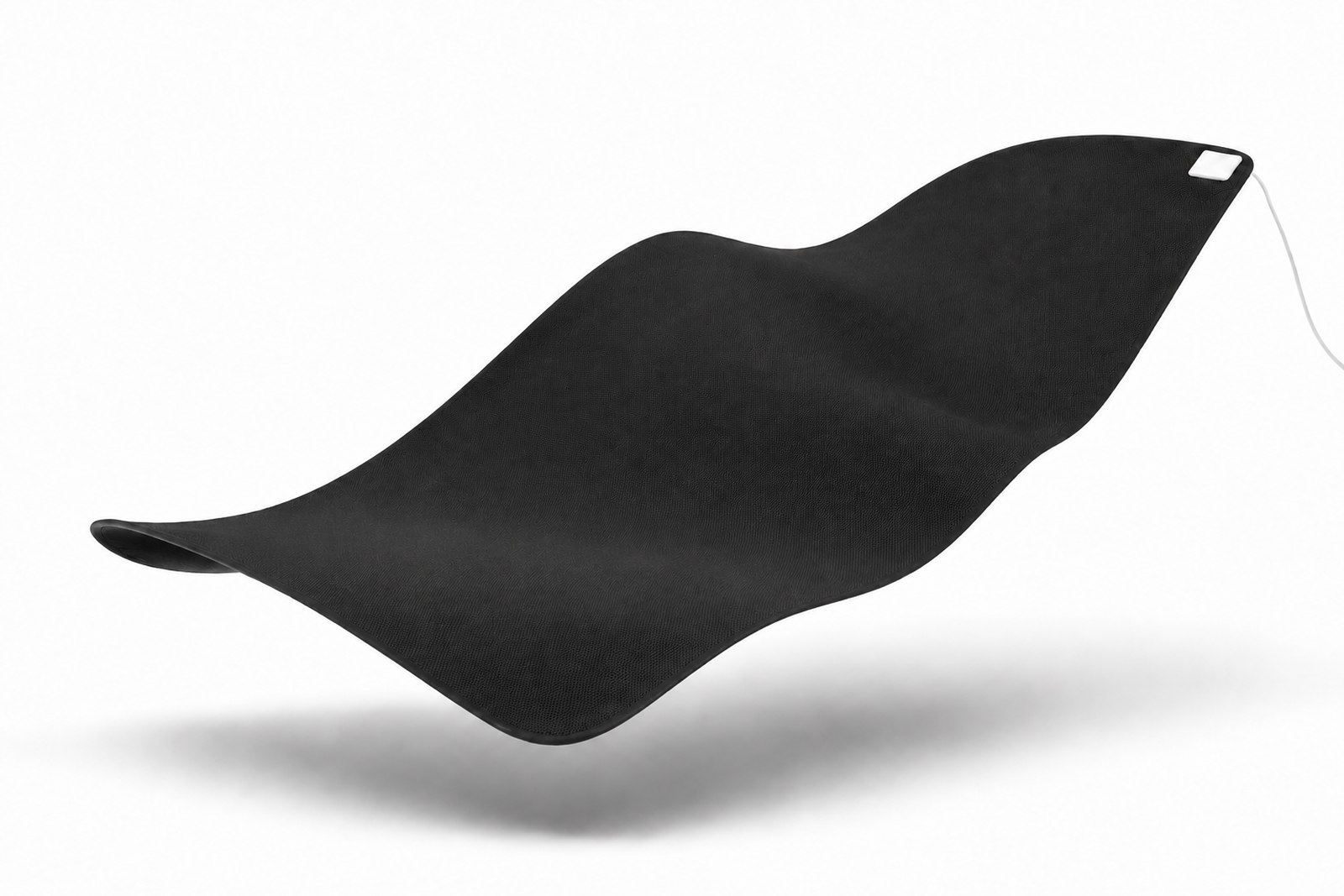
Five textile layers with no rigid frame or board: the whole mat rolls up for storage and transport, and is straightforward to size to a given bed.
One mat is the standard configuration; the compute unit, posture algorithm, wireless module and custom sizing are all options.
Both models share the same sensing principle and the same electrical and output specification. Only the width and the lateral point count differ: PS90 for a 90 cm-class single bed, PS180 for a 180 cm-class double. The 32 rows along the bed stay the same; the lateral count doubles from 16 to 32.
A 16 × 32 array of 512 points. 850 × 1850 mm overall, 750 × 1700 mm sensing area, about 1000 g.
A 32 × 32 array of 1024 points, resolving each side of a double bed separately. 1800 × 2000 mm overall, 1600 × 1800 mm sensing area. Electrical and output specifications are identical to PS90.
Custom sizes are available for both models.
Body-pressure evaluation in retail bed-selection systems and mattress development, showing support differences at a glance.
Monitoring which areas bear load and for how long in long-term bedridden care, informing repositioning.
With the posture algorithm, pressure distribution distinguishes supine, side and prone positions and the turns between them.
Contact-pressure measurement for adaptive car seats, adaptive sofas and sports monitoring — the distribution can drive automatic support adjustment.
| Model | PS90 / PS180 |
|---|---|
| Overall size | PS90: 850 × 1850 mm PS180: 1800 × 2000 mm (both customisable) |
| Sensing area | PS90: 750 × 1700 mm PS180: 1600 × 1800 mm |
| Sensing grid | PS90: 16 × 32 (512 points) PS180: 32 × 32 (1024 points) |
| Point size | 20 × 20 mm |
| Gap between points | 25 mm |
| Weight | approx. 1000 g (PS90) |
| Layers | 5 all-textile layers |
| Operating voltage | 3.3 V / 5 V (customisable) |
|---|---|
| Operating current | < 200 mA |
| Response time | < 100 ms |
| Sampling rate | 5 Hz |
| ADC resolution | 12-bit |
| Signal type | Digital |
| Interface | UART or USB |
| Operating range | 10–40 °C, 5–90% RH non-condensing |
Options: custom sizes, a compute unit with the posture-monitoring algorithm, and a wireless module. Figures here are for product description; the shipped technical documentation governs.
The S100 flexible strip and the X100 adjustable-bed sensor cover sleep monitoring without a full-bed pressure array.