Hardware Product Specification
S100 Dual-Mode Sleep Sensing Strip
Piezoresistive and piezoelectric sensing fused in a 1.5 mm fabric laminate.
An OEM module for mattresses, smart beds and elder-care systems.
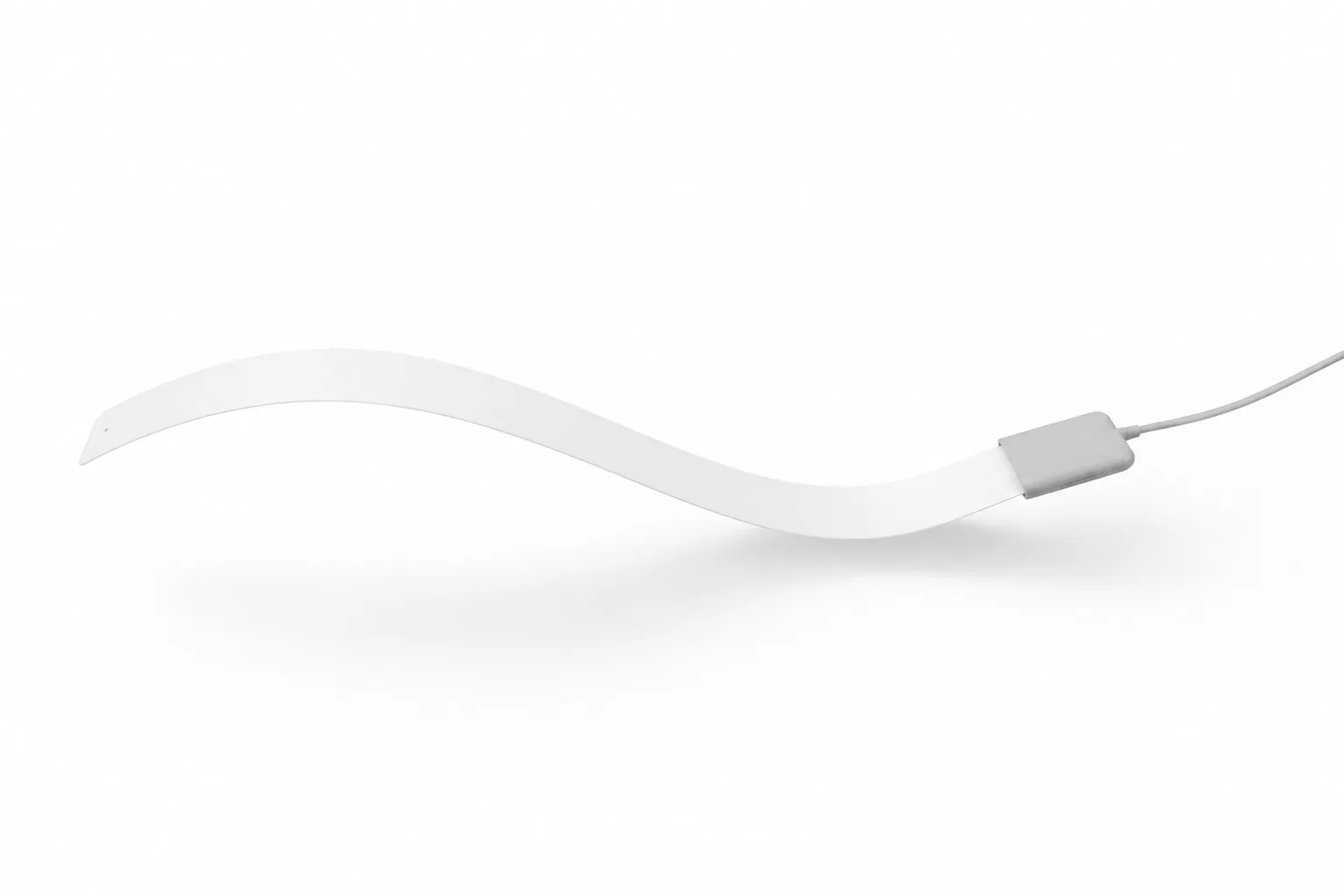
Piezoresistive and piezoelectric sensing fused in a 1.5 mm fabric laminate.
An OEM module for mattresses, smart beds and elder-care systems.
The piezoresistive layer reads static body-pressure distribution; the piezoelectric layer captures micro-vibration from the heartbeat. Both are sampled synchronously on the same strip and cross-validate each other — pressure answers presence, piezo answers vitality.
Resistive and conductive fabrics form a pressure-sensitive divider network with continuous output.
The BCG signal is band-split to extract beat-to-beat cardiac activity and the respiration envelope.
Raw signals are sampled at 200 Hz, then filtered, split, feature-extracted and decided entirely on the device. Heart rate and HRV refresh every 4 s; a data frame is emitted every second. No network required at any stage.
Cardiac and respiration channels use independent band-pass designs so body movement does not leak into the heart-rate path. Apnoea is flagged as a low-amplitude event lasting ≥10 s.
Multiple functional layers are heat-laminated into a single body, laser-formed, with a riveted terminal. No rigid frame — it deforms with the mattress and resists crease failure under repeated load.
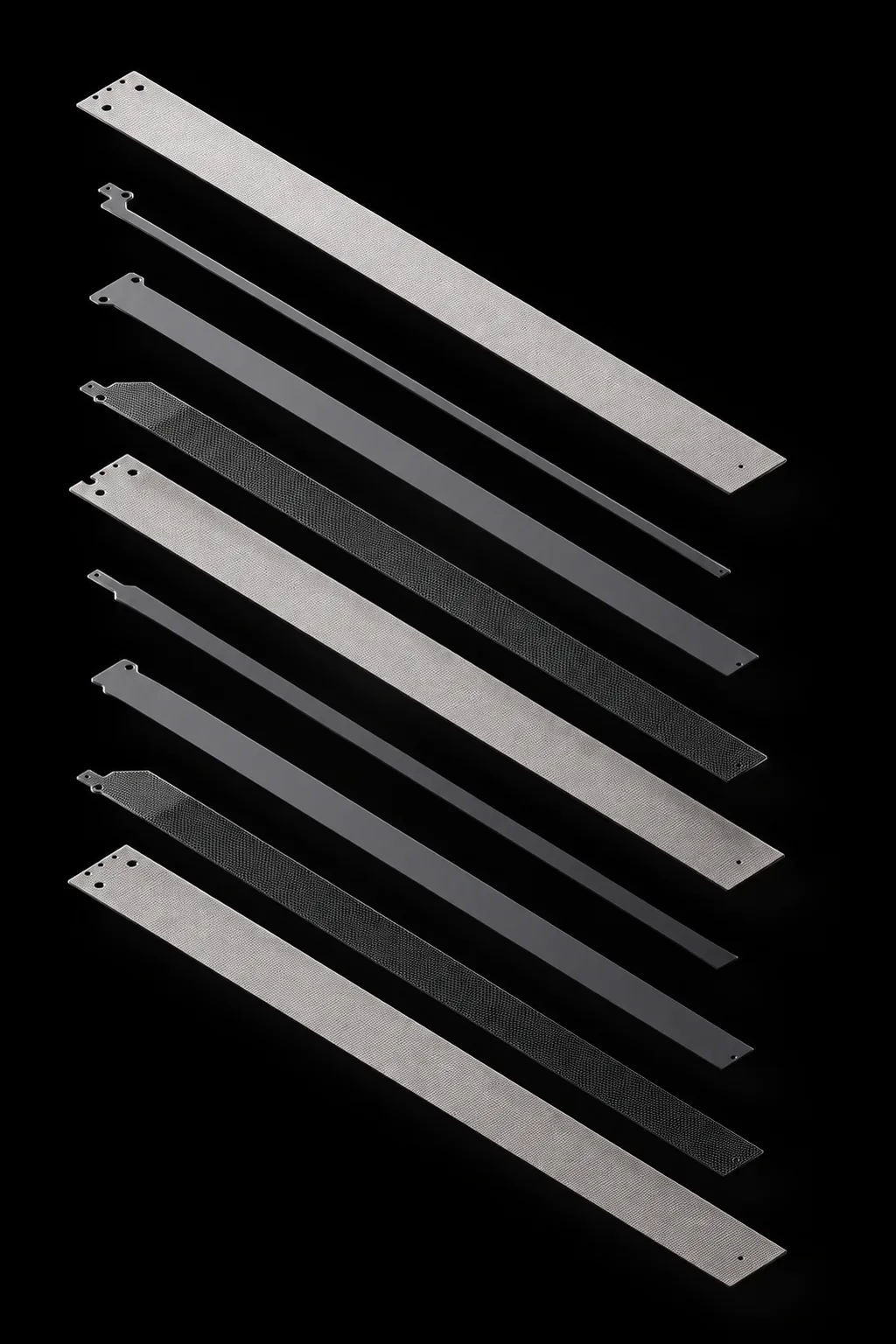
Material composition, layer order and process parameters are proprietary; full technical documentation is available under NDA.
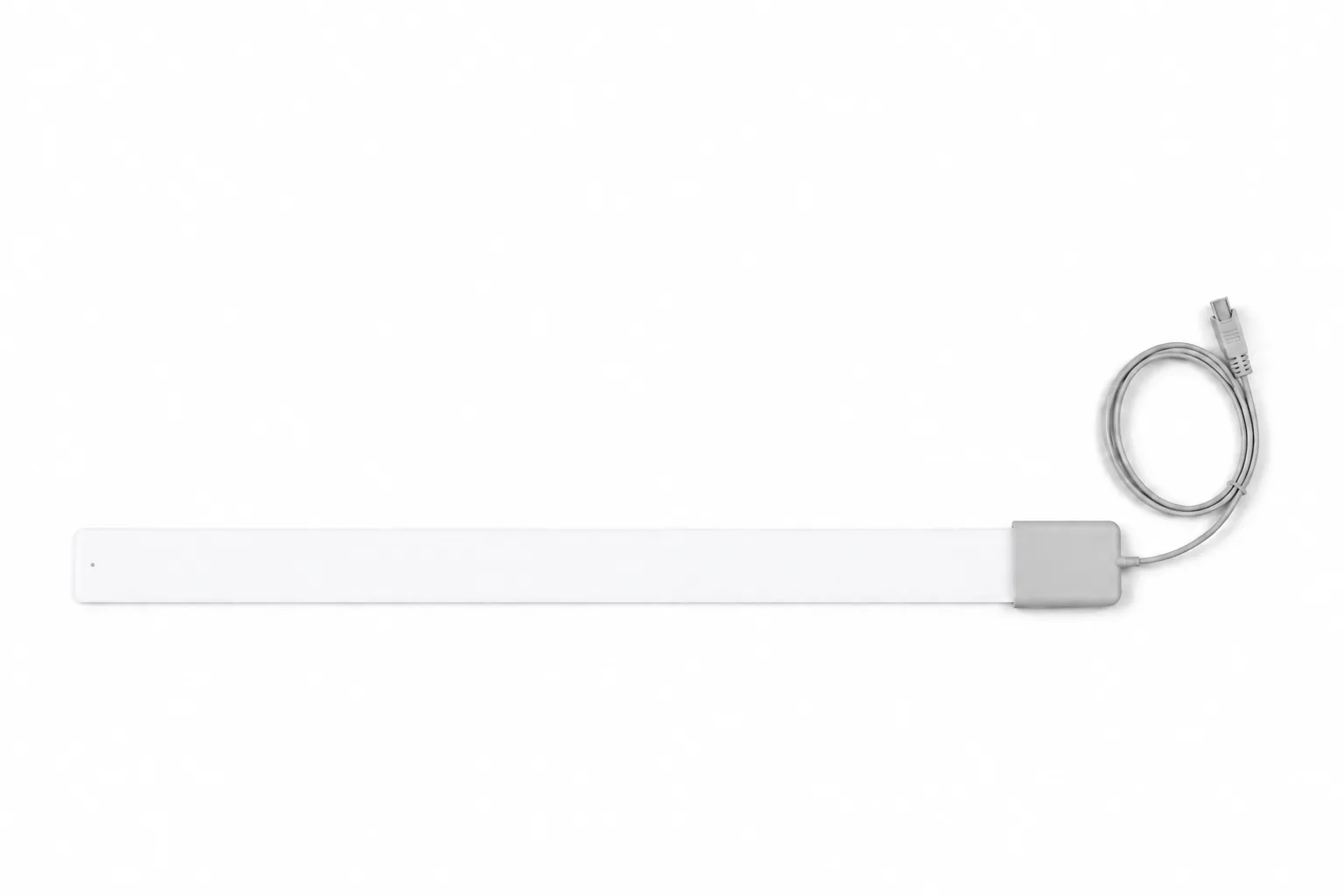
A 40 × 550 mm sensing area at 1.5 mm sensor thickness. Lay it between mattress and base, or sew it into a topper. With no rigid parts it leaves mattress rebound unchanged and stays imperceptible to the sleeper.
| Sensing area | 40 × 550 mm |
|---|---|
| PCB size | 40 × 55 mm |
| Sensor thickness | approx. 1.5 mm |
| Deployment | Under-mattress or sewn into topper |
At 1.5 mm with no rigid frame, S100 can be sealed inside the finished product on the production line. It ships as part of the host product — invisible and imperceptible to the end user.
Integrated with a heating or cooling blanket it closes the loop: S100 supplies sleep stage and body movement, the thermal system adjusts accordingly — cooling at sleep onset, holding through deep sleep, warming before wake — with no manual setting.
Sealed between the cover and comfort layers, shipped with the mattress, leaving rebound feel and appearance unchanged.
Close to the head and neck for a higher signal-to-noise ratio on micro-movement and snoring — suited to snore-monitoring products.
Works simply laid between mattress and base — no change to mattress construction, ideal for retrofitting existing models.
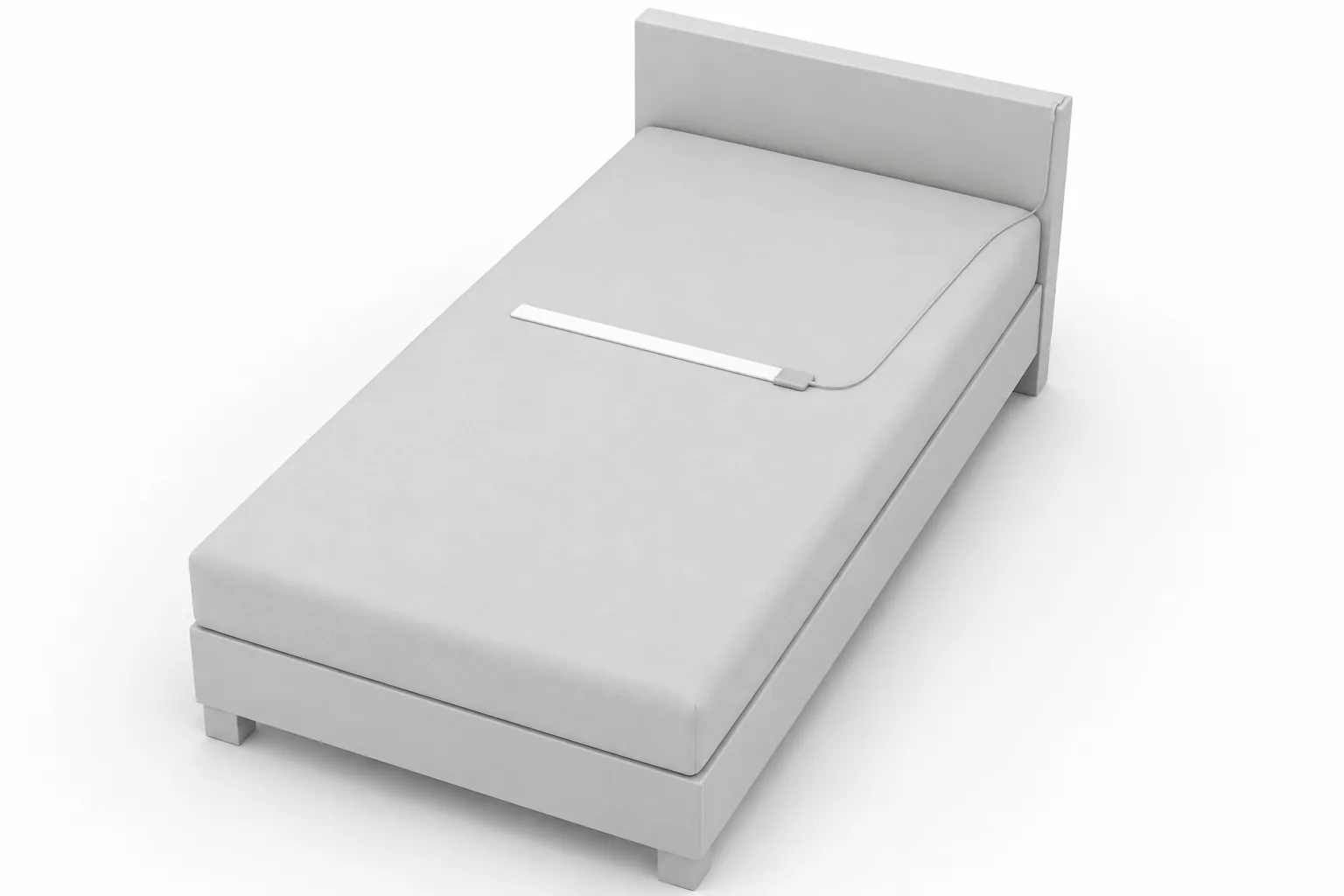
Retrofit layout: a single strip laid across the chest area, cable routed along the base to the head end.
| Heart rate | 40–110 bpm, accuracy >95% |
|---|---|
| Respiration rate | 10–30 breaths/min, error ±3 |
| Bed/exit detection | Response ≤10 s |
| Body movement | Toss-turn + micro-movement |
| Snoring | TensorFlow voiceprint AI |
| Data output | One frame per second |
| Sleep score | 0–100 composite rating |
|---|---|
| Sleep stages | Deep / Light / REM / Awake, 20 s granularity |
| Time tracking | Bed-in, sleep-onset, wake-up, get-up |
| Vital signs | HR avg / max / min + HRV |
| Night awakenings | Count & duration statistics |
| Respiratory events | ≥10 s low-amplitude event count & duration |
The algorithm loop runs locally on the module with no cloud or network dependency. Biometric data never leaves the device, avoiding cross-border transfer and third-party sharing risk. (A cloud-enabled version is available as an option.)
Nothing is uploaded; full functionality without an internet connection. (Cloud version optional.)
Sleep data stays exclusively on the device and enters no third-party pipeline.
Reading and erasing biometric data is entirely under the end user's control.
Complete nightly reports retained locally for long-term trend review.
The module operates without a host, keeping integration cost low.
Under 70 USD per bed, suited to volume production programmes.
One hardware platform supports three interfaces. Choose by whether the end product has its own controller and whether it is networked — the strip itself does not change.
Direct to the host controller with the lowest latency and power. Suited to smart beds and mattress control boxes that already have an MCU or SoC.
Wireless link to a phone app or gateway. Suited to standalone and retrofit deployments without a host controller.
For viewing data when you are not beside the device — checking on a parent from afar, a nursing station reviewing all rooms, or pulling up last night\u2019s report from anywhere.
| Model | S100 |
|---|---|
| Sensing area | 40 × 550 mm |
| PCB size | 40 × 55 mm |
| Sensor thickness | approx. 1.5 mm |
| Construction | Nine-layer heat-laminated fabric |
| Sensing principle | Piezoresistive + piezoelectric |
| Interface | UART / BLE / Wi-Fi, selectable |
| Sampling rate | 200 Hz |
|---|---|
| Channels | BCG / pressure / sound — 3 channels |
| Cardiac band-pass | 0.6 – 2.5 Hz |
| Respiration band-pass | 0.1 – 0.5 Hz |
| HR refresh | Every 4 s (60 s sliding window) |
| Frame output | Every 1 s |
| Compute & storage | Fully on-device, no cloud (cloud version optional) |
Figures on this page are for product description; the shipped technical documentation and test reports govern.