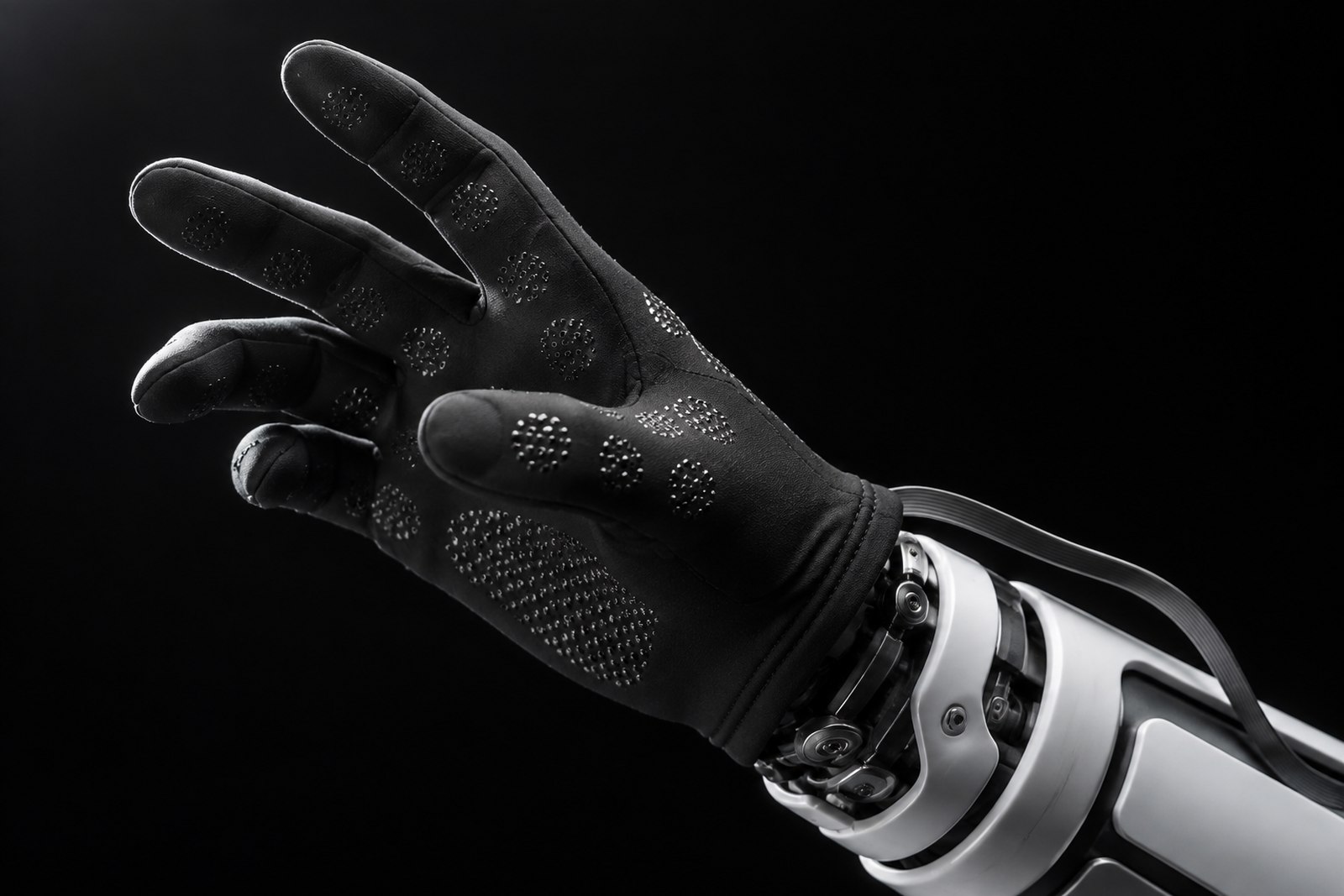
A wearable layer of fabric electronic skin — flexible pressure points are woven into the textile itself, with no rigid sensing components. The standard configuration puts 174 points across the palm and every finger joint, feeding contact pressure back for dexterous robot manipulation and tactile data collection; point count and zoning can be tailored per project.
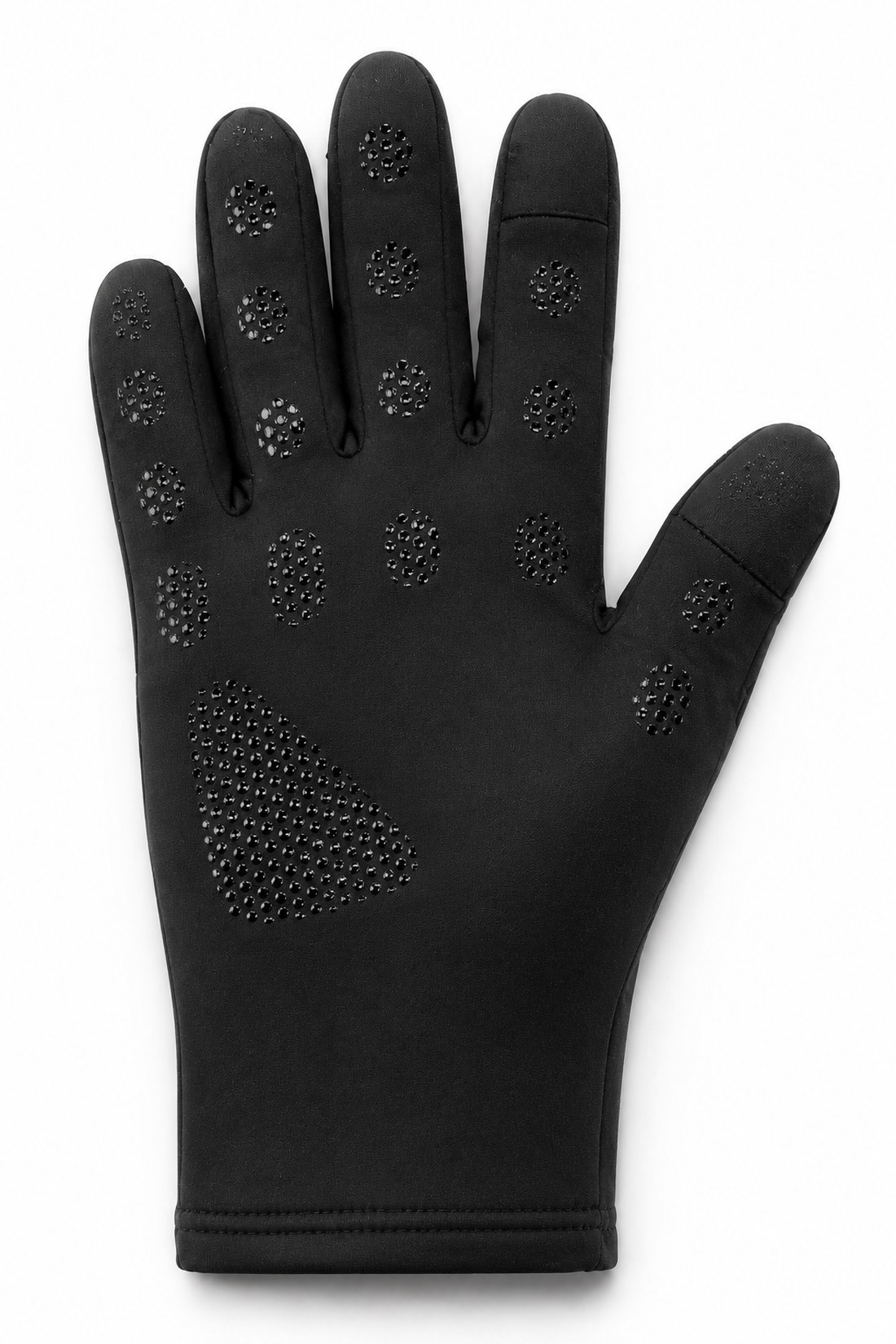
Left: the all-fabric glove itself. Right: the live point cloud in the host software, where pressure intensity drives point size, lift and brightness at once.
The points are not spread evenly — they follow how force actually lands during a grasp: 99 across the palm for the main holding load, a 3 × 3 patch of 9 on every fingertip pad for pinch contact, and 6 more on the second and third phalanges to track wrap and curl.
The main load-bearing region in a grasp, with the highest point density — resolving the difference between heel, centre and knuckle loading.
A nine-point array on each fingertip pad covers the primary contact patch for pinching and fine manipulation, resolving where within the pad contact lands.
Six points on the second and third phalanges track how the finger wraps around an object — feeding grasp-posture and slip detection.

The sensing layer is a woven row-and-column matrix in which every crossing is an independent pressure point, with all traces gathered into a flexible tail at the wrist. Because it is woven, point count, spacing and zoning can all be changed per project — 174 is simply the standard configuration.
Delivered as a left/right pair. Point numbering maps physical location to data-array index for both hands, so handedness never gets confused during algorithm development.
Real-time contact pressure feeds the control loop for grasp-force monitoring and modulation — neither crushing nor dropping.
Worn on a human hand to record dexterous manipulation, paired with action labels, object type and timestamps — a tactile channel for imitation learning and policy training.
A validation platform for tactile algorithms: contact-state classification, slip warning, force estimation and contact-location regression.
Grip and movement assessment in rehabilitation, and hand-contact behaviour logging for human–machine interaction research.
| Model | HP01 |
|---|---|
| Glove size | 160 × 260 mm |
| Material | Polyester textile, fully fabric-based |
| Sensing points | 174 standard (99 palm + 3 × 3 per fingertip + 6 per phalanx), customisable |
| Sensing regions | Fingertips / pads / palm |
| Pressure range | 100 gf |
| Pressure resolution | 8-bit |
| Response time | 0.1 s |
| Sampling rate | 10 Hz (customisable) |
| Delivered as | Left/right pair |
| Power | USB 5 V |
|---|---|
| Current | 100 mA |
| Interface | USB / serial |
| Serial settings | 115200 8N1 |
| Operating temp. | −20 … 60 °C |
| Operating humidity | 0 … 98% RH |
| Storage | −20 … 60 °C, 0 … 98% RH |
| Flex endurance | 10,000 cycles |
| Cleaning | Not washable; wipe with a dry cloth |
| Host requirements | USB port, 12 GB RAM or more |
Sensing regions, point count, interface protocol and sampling rate can all be tailored to a project. Figures follow product manual V0.1; the production or engineering-sample documentation governs.
The PS90 / PS180 mats cover a whole bed with 512 or 1024 points for body-pressure distribution and posture analysis.